01 / INSTALLATION
The installation
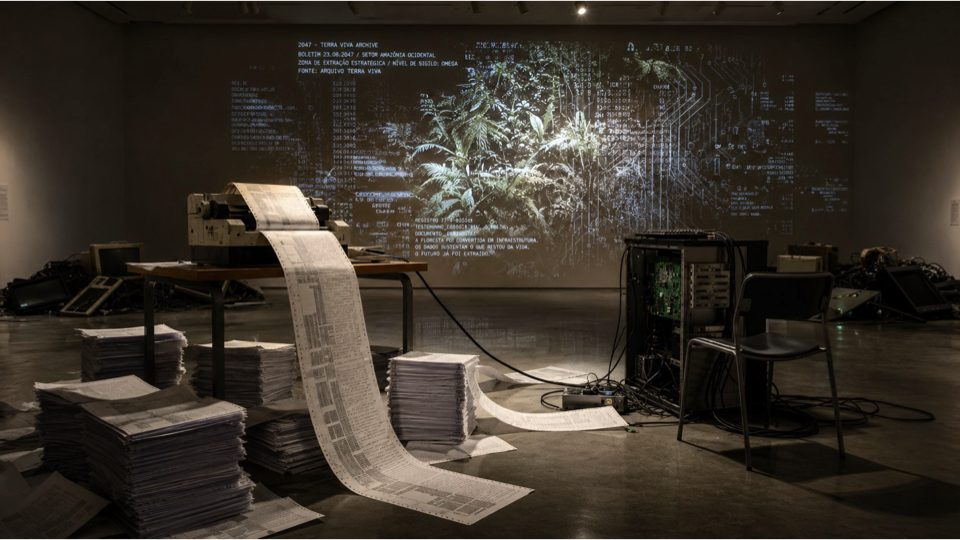
2047 is also an installation. Its fictional narrative unfolds through printing, images and videos generated by artificial intelligence.
The videos in development form part of the work’s audiovisual dimension, in dialogue with its chapters written by an AI agent, based on the news and studies it collects, and with the materiality of the machine.
From 15 October 2026 at Casa Firjan · Rio de Janeiro
Technical requirements
Ideal space conditions
- Ceiling height. At least 3 m of real clear height. A low, horizontal room suits the work.
- Ambience. Dark. The projection is the main light source in the room.
- Projection wall. Medium matte grey (LRV between 45 and 55), smooth, with no visible texture or joints, painted corner to corner.
- Circulation. Visitors move around three sides of the apparatus, with the front kept clear for reading the projection.
- Paper area. Sized for a high printing cadence, with room for a pile up to 90 cm high covering about 3.5 × 3.5 m of floor by the end of the run.
Projection
- Laser projector, at least 4,500 lumens, WUXGA or Full HD resolution, with good brightness on a grey wall.
- 16:9 image, as large as brightness allows, around 4.5 to 5 m wide, with its base close to the floor.
- Ceiling mount next to the wall, or a low box on the floor in front of the apparatus. A long-throw projector at the back of the room will not work, since visitors would cast shadows on the image all the time.
Light
- Dark room.
- One warm, narrow spot (2700 to 3000 K) on the printer and the paper. Everything else off or cold.
- Minimal floor marking for circulation.
Power
- Dedicated, stable circuit for the apparatus.
- Continuous 24-hour operation, including when the venue is closed, formally authorised under the fire code.
- UPS sized for the apparatus, so printing is not lost in a power cut.
Structure and furniture
- Rack or low structure for the equipment.
- Low bench along the wall for the folded paper archive.
- Paper perimeter marked on the floor, with no tall barrier hiding the pile.
Network
- Stable internet link for news collection.
Materials supplied by the artists
- Wide-carriage dot matrix printer.
- Computer that runs the model and drives the printer.
- Continuous form paper, with stock for replacement.
- Ribbons and other printer consumables.
- Cameras for monitoring and timelapse, framed so no visitor is identifiable.
- Light sign.
- Technical backup. A second printer and a second computer stay on site, already configured, only as a backup the venue team can swap in case of failure.
Operation during the run
- The work is run by the venue team, trained by the artists during installation week. The local team changes ribbon and paper, aligns the tractor feed and restarts after power cuts.
- The artists monitor remotely, with an automatic alert if the work stops, and travel only in serious cases.
- A person appointed by the venue is responsible for daily operation, with a substitute and weekend cover.
Sound and property
- The noise of the dot matrix printer is an aesthetic layer of the work. It requires written acceptance and can be adapted to the venue standards, in dialogue with other works and staff needs.
- Fire load to consider, given the growing paper pile and equipment running 24 hours. Safety rules should be validated with the venue fire brigade.
- Check-in and check-out term, with an inventory signed at installation and deinstallation.
Pre-production requirements
- Floor plan and real clear height of the projection wall.
- Dedicated power point and feasibility of 24-hour operation.
- Projector and mounting method.
- Painting the wall matte grey.